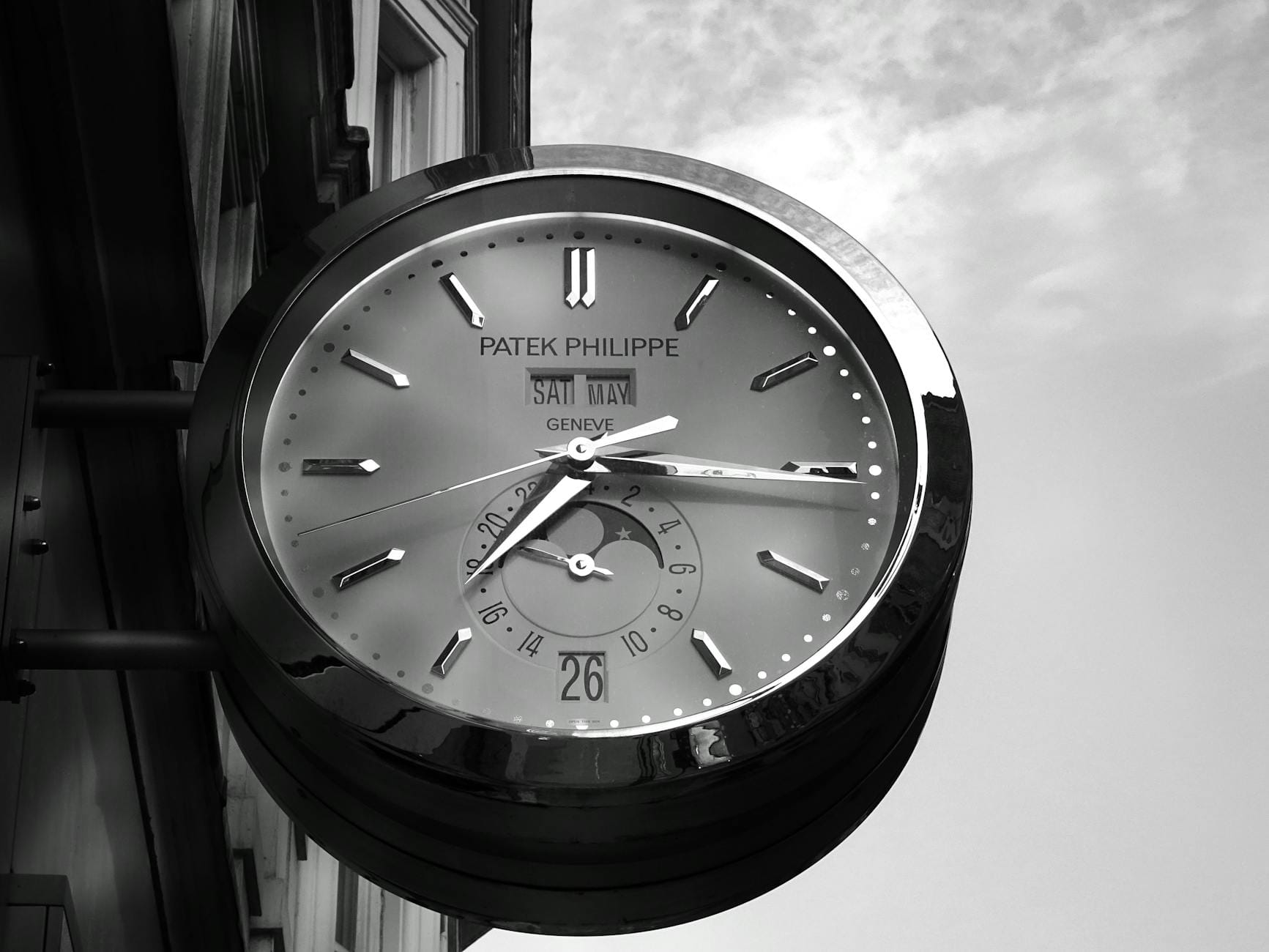
Three watches demand collector attention: a rare Movado Polyplan (CHF 8,000–30,000), an original-condition Rolex 1680 (USD 40,000–150,000+), and a full-set Patek 3970 (CHF 60,000–150,000+). All three reward documentation and condition discipline over brand speculation.
Bring a Loupe: Three Watches Worth Serious Collector Attention
Serious watch collectors know that the most instructive moments in this market arrive not at the major auction houses but in the quieter, more granular secondary market — where a single reference number, a dial variant, or a complete set of papers can shift a hammer price by tens of thousands of dollars. This week, three watches demand close inspection: a rare Art Deco Movado Polyplan, an extraordinarily difficult Rolex 1680 variant that many consider nearly unobtainable in honest condition, and a full-set Patek Philippe 3970 that represents one of the cleanest entry points into perpetual calendar collecting available today. Each piece carries its own provenance weight, its own market logic, and its own argument for why a discerning collector in Hong Kong, Singapore, Tokyo, or Taipei should be paying close attention right now.
The Movado Polyplan: Art Deco Engineering at Its Most Uncompromising
The Movado Polyplan is one of the most architecturally ambitious wristwatches produced in the early twentieth century, a three-plane curved movement designed to conform to the shape of the human wrist at a time when most watchmakers were still treating the wrist as a flat surface. Produced in limited numbers between approximately 1912 and the 1930s, surviving examples in wearable condition are genuinely scarce — auction appearances number in the dozens globally per year, not the hundreds. The movement itself, Calibre 150M, was engineered so that its three sections pivot along two axes, a feat of micro-mechanical thinking that still draws admiration from watchmakers today.
When a clean Polyplan in yellow gold appears with an unrestored dial and matching case, estimates typically open in the CHF 8,000 to CHF 15,000 range, with strong examples clearing CHF 20,000 to CHF 30,000 at specialist sales. For Asian collectors who have built positions in early Patek tonneau cases or Cartier Art Deco rectangulaires, the Polyplan represents a logical and historically significant adjacency — a watch that predates the Swiss luxury hierarchy as we know it and carries genuine horological invention rather than brand prestige alone. Provenance matters enormously here: examples with documented single-family ownership histories command meaningful premiums over dealer-sourced pieces with opaque custody chains.
The Impossible Rolex 1680: Why Condition Is Everything
The Rolex Submariner reference 1680 was produced from 1969 through 1980, and within that eleven-year run sits one of the most condition-sensitive collecting categories in the entire vintage Rolex universe. The reference is called impossible not because examples are rare in raw numbers — the 1680 was a production watch, not a limited edition — but because finding one with an unpolished case, original crown and tube, matching-date movement, and an undamaged, unfaded dial that has not been touched by a dial restorer is genuinely extraordinary. The matte black dial variants, and particularly the red-text Submariner examples from the earliest production years, have traded at auction between USD 40,000 and USD 120,000 depending on condition and completeness, with the most pristine examples breaching USD 150,000 at Phillips and Christie's in recent cycles.
For collectors in Asia, the 1680 carries additional resonance because a significant number of these watches entered the region through military and diplomatic channels during the 1970s, and some of the cleanest surviving examples have emerged from Japanese and Hong Kong collections where watches were stored rather than worn daily. The lesson the 1680 teaches is one every serious collector must internalize: in vintage Rolex, the difference between a watch worth USD 25,000 and one worth USD 100,000 is often invisible to the naked eye and requires exactly the kind of loupe inspection the headline demands. Rehaut engravings, crown logo depth, lume plot consistency, and case bevel sharpness are not cosmetic details — they are the entire argument.
The Full-Set Patek Philippe 3970: A Perpetual Calendar at a Rational Entry Point
The Patek Philippe reference 3970 was produced from 1986 to 2004 and represents the last generation of Patek perpetual calendar chronographs built on the ebauche-based Calibre CH 27-70 Q movement before the manufacture transitioned to the fully in-house Calibre CHR 29-535 PS found in the current 5270. A full set — meaning original box, both sets of papers, hangtag, and ideally the Patek service card if the watch has been through the manufacture — transforms what is already a compelling watch into a complete archival object. Full-set 3970 examples in yellow gold have traded between CHF 60,000 and CHF 95,000 at major auction houses in the past two years, while white gold and platinum references command significant premiums, with platinum examples clearing CHF 150,000 when documentation is complete.
The 3970 matters to Asian collectors for several compounding reasons. First, it sits at the intersection of two of the most actively collected Patek categories — perpetual calendars and chronographs — in a single reference. Second, the 3970 has historically been undervalued relative to the 2499 and 1518 perpetual calendar chronographs that precede it, meaning appreciation potential remains real for collectors entering now with full-set examples. Third, and perhaps most importantly for collection-building logic, the 3970 is old enough to carry genuine vintage character but recent enough that service histories are traceable and movement condition is rarely catastrophic. A collector in Taipei or Singapore who secures a full-set 3970 today is acquiring a watch that functions simultaneously as a wearable object, a historical document, and a store of value — the trifecta that defines serious horological collecting.
What These Three Watches Tell Us About the Market Right Now
Taken together, the Polyplan, the 1680, and the 3970 illustrate a single governing principle of the current secondary watch market: documentation and condition are outpacing brand recognition as the primary drivers of value. Buyers who paid brand premiums for polished, undocumented examples two and three years ago are finding the resale environment less forgiving than they anticipated. Meanwhile, collectors who have been patient, who have studied references deeply, and who have waited for correctly presented pieces with clean provenance chains are finding that the market is rewarding exactly that discipline. For Asian collectors specifically, who have historically been among the most rigorous in demanding complete sets and original condition, this moment represents a structural vindication of an approach that was sometimes dismissed as overly cautious during the peak enthusiasm of 2021 and 2022.
- Movado Polyplan: Estimate range CHF 8,000–30,000 depending on metal, dial condition, and provenance
- Rolex 1680 Submariner: USD 40,000–150,000+ for unpolished, full-original examples; red-text variants at the top of the range
- Patek Philippe 3970 full set: CHF 60,000–95,000 yellow gold; CHF 150,000+ platinum with complete documentation
The collector who brings a loupe — literally and figuratively — to each of these references will find that the stories they tell are worth far more than their hammer prices alone. That is the enduring argument for serious collecting over speculative buying, and it is an argument that the Asian collector community has been making, quietly and correctly, for decades.
🥃 Building a whisky cask collection? Whisky Cask Club curates rare Scottish casks for private collectors across Asia.
Frequently Asked Questions
What makes the Movado Polyplan so rare compared to other vintage dress watches?
The Polyplan's three-plane curved movement required exceptional manufacturing precision that very few watchmakers attempted, limiting total production numbers significantly. Surviving examples in unrestored condition are scarce because the curved case and dial are prone to damage during amateur servicing, and many pieces were altered or cannibalised over the decades.
How do I verify whether a Rolex 1680 dial is original and unrestored?
Authentication requires examining lume plot consistency under magnification, checking that the printing layers show appropriate age patina without reapplication marks, and verifying that the dial feet have not been resoldered. A specialist loupe examination combined with UV light inspection will reveal most restorations. Always request a condition report from a recognised Rolex specialist before purchasing.
Why does a full set matter so much for the Patek Philippe 3970's value?
Patek Philippe's documentation — original box, papers, hangtag, and service records — confirms authenticity, establishes the watch's history within the manufacture's own records, and significantly reduces buyer risk. Full-set examples typically command a 20–35% premium over watch-only pieces of equivalent condition, and that premium has been widening as the collector base becomes more sophisticated.
Are these watches likely to appreciate further, or has the vintage watch market peaked?
The broad speculative peak of 2021–2022 has corrected, but condition-correct, fully documented examples of historically significant references have held value more robustly than undocumented or polished pieces. Analysts tracking secondary market data suggest that the top tier of each reference — defined by condition and completeness — continues to find strong bidding, while mid-tier examples face more price pressure.
Where do Asian collectors typically source watches like these?
Major auction houses including Phillips, Christie's, and Sotheby's hold dedicated watch sales in Hong Kong and Geneva that attract strong Asian bidding. Specialist dealers in Tokyo's Ginza district and Singapore's Raffles Place area maintain inventories of vetted vintage references. Private treaty sales through trusted intermediaries are increasingly common for high-value pieces where discretion is preferred.