Stone dial watches are a serious collecting category in 2026, with top references from Patek, Vacheron, and AP commanding 30–78% premiums. Asian collectors hold a cultural advantage in evaluating these pieces. Provenance documentation and dial integrity certification are essential.
Stone Dial Watches: Why 2026 Is the Year Serious Collectors Are Paying Attention
Stone dial watches have moved well beyond novelty status. In 2026, the finest examples featuring malachite, onyx, aventurine, lapis lazuli, and meteorite dials are commanding serious prices at auction and through authorised dealers across Hong Kong, Singapore, and Tokyo. At the April 2026 Phillips Hong Kong sale, a Patek Philippe ref. 5711/1300A-001 with a jade-green dial — one of only 170 pieces produced for the final run — hammered at HKD 3.2 million (approximately USD 410,000), against a pre-sale estimate of HKD 1.8–2.4 million. That result, achieved in under ninety seconds of bidding, confirmed what regional collectors already suspected: stone dials are no longer a subcategory. They are a collecting discipline in their own right.
What Makes Stone Dials Genuinely Rare — and Genuinely Risky
The challenge with stone dials begins at the quarry. Gem-quality slabs of consistent colour and thickness suitable for watch dials are extraordinarily scarce. A single block of Siberian charoite, for example, may yield fewer than a dozen dial-grade slices before the pattern becomes unusable. Audemars Piguet's Royal Oak ref. 15400ST with a meteorite dial — sourced from the Gibeon meteorite field in Namibia, material roughly 4.5 billion years old — retails at CHF 28,500 through authorised dealers, but grey market premiums in Singapore and Taipei routinely push transaction prices to CHF 38,000–44,000. Each dial carries a unique Widmanstätten pattern, meaning no two watches are identical, a provenance argument that resonates powerfully with Asian collectors accustomed to evaluating uniqueness in jade, celadon, and imperial porcelain.
The risk is equally real. Stone is brittle. A hairline fracture invisible to the naked eye at purchase can propagate over years of thermal cycling. Reputable sellers — Wempe, Watches of Switzerland, and the major maisons' own boutiques — will provide certification of dial integrity, but the secondary market is less disciplined. Collectors acquiring stone dial pieces at auction should insist on macro-photography of the dial surface and, where possible, independent gemological assessment before bidding.
The Standout References of 2026
Several references have defined the stone dial conversation this year. Vacheron Constantin's Overseas ref. 4500V with a hand-selected turquoise dial — part of a 55-piece limited edition released in February 2026 — sold out across Asia within 72 hours of allocation. Secondary market prices in Hong Kong have already reached CHF 52,000 against a retail of CHF 36,500, a premium of approximately 42% in under four months. Rolex, characteristically restrained, refreshed its Day-Date 40 offerings with a new tiger's eye dial variant in yellow gold, priced at USD 46,550 retail; grey market premiums in Tokyo's Ginza district are currently running at 25–30% above list. IWC Schaffhausen's Portofino Hand-Wound with an onyx dial — clean, architectural, and priced at CHF 9,800 — represents the most accessible serious entry point in the category, with waiting lists forming at authorised dealers across Southeast Asia.
- Vacheron Constantin Overseas Turquoise (55 pcs): Retail CHF 36,500 | Secondary HKD equivalent ~CHF 52,000
- Patek Philippe ref. 5711/1300A-001 Jade: Hammer HKD 3.2M at Phillips Hong Kong, April 2026
- Audemars Piguet Royal Oak Meteorite: Retail CHF 28,500 | Grey market CHF 38,000–44,000
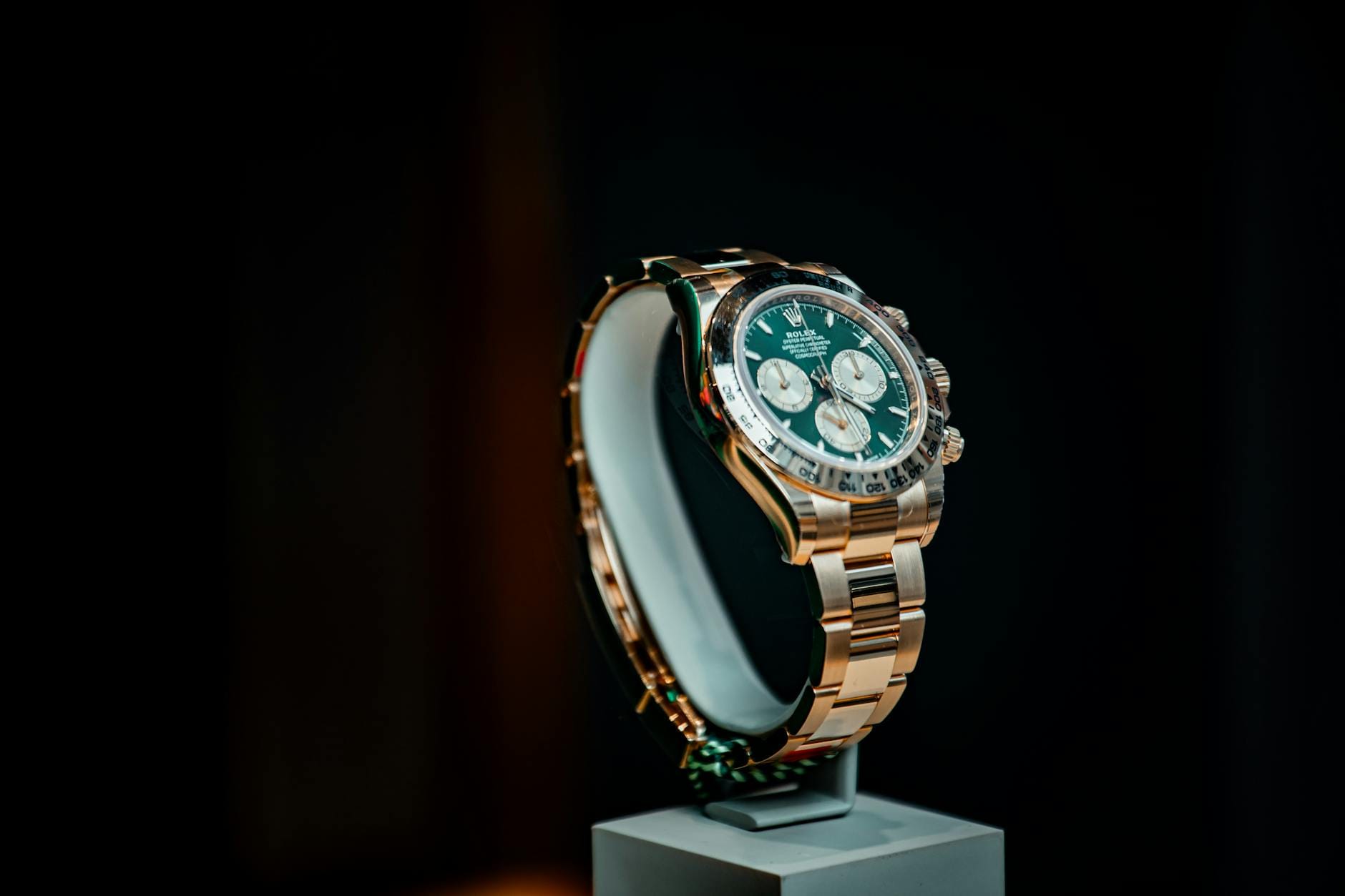
- Rolex Day-Date 40 Tiger's Eye: Retail USD 46,550 | Tokyo grey market +25–30%
- IWC Portofino Onyx: Retail CHF 9,800 | Best accessible entry point in category
Why Asian Collectors Are Positioned to Lead This Market
The cultural resonance of stone in Asian collecting traditions cannot be overstated. Chinese literati collectors have prized scholar's rocks, jade carvings, and inkstones for over a thousand years. The aesthetic vocabulary of stone — its veining, its colour depth, its geological provenance — maps directly onto sensibilities that serious Asian collectors have cultivated across multiple categories. A lapis lazuli dial sourced from the Sar-e-Sang mines of Afghanistan, the same deposit that supplied ultramarine pigment to Renaissance painters and blue glaze to Ming dynasty potters, carries a provenance chain that a seasoned collector in Beijing or Taipei will recognise immediately. This cross-category fluency gives Asian buyers a genuine interpretive advantage over collectors approaching stone dials purely as horology.
Auction house specialists at both Sotheby's and Christie's have noted a marked increase in Asian buyer participation in stone dial lots over the past 18 months. Sotheby's Geneva reported that 38% of stone dial hammer prices in their November 2025 sale were attributable to Asian telephone and online bidders — up from 21% in the equivalent 2023 sale. That trajectory suggests the category is still in its accumulation phase for regional collectors, with price discovery ongoing rather than complete.
Building a Stone Dial Collection: Where to Start
For collectors entering the category in 2026, provenance documentation is non-negotiable. Insist on original box and papers, and where available, the maison's certification of the specific stone origin. Avoid undocumented grey market pieces regardless of apparent condition. Diversify across stone types — meteorite and malachite occupy different aesthetic and price registers, and a coherent collection tells a geological story as much as a horological one. Budget a minimum of CHF 10,000–15,000 for a credible entry-level piece with genuine secondary market liquidity, and treat anything below that threshold as decorative rather than collectible. The most important rule: buy the dial first, the movement second. In this category, the stone is the asset.
Frequently Asked Questions
What are the most collectible stone dial watch references in 2026?
The Vacheron Constantin Overseas turquoise (55-piece limited edition), Patek Philippe ref. 5711/1300A-001 jade, Audemars Piguet Royal Oak meteorite, and Rolex Day-Date 40 tiger's eye are the benchmark references. Each combines scarcity of the dial material with strong maison provenance and documented secondary market premiums.
How do stone dial watches appreciate compared to standard dial references?
Premium stone dial references from top maisons have appreciated 30–60% above equivalent standard dial models over the past three years, based on Phillips and Sotheby's auction data. The Patek 5711 jade example achieved a 78% premium over its pre-sale high estimate at the April 2026 Phillips Hong Kong sale, outperforming the steel bracelet variant by a significant margin.
What provenance documentation should collectors require for stone dial watches?
At minimum: original box and papers, maison certification of dial integrity, and where possible, documentation of the stone's geographic origin. For meteorite dials, independent gemological confirmation of Widmanstätten pattern authenticity is advisable. Auction house catalogue notes from Phillips, Sotheby's, or Christie's constitute strong provenance anchors for secondary market pieces.
Are stone dials fragile? What are the ownership risks?
Stone dials are significantly more fragile than metal or enamel dials. Thermal shock, impact, and improper servicing can cause fractures. Collectors should store stone dial watches away from temperature extremes, avoid daily wear, and use only maison-authorised service centres. Pre-purchase macro-photography and independent gemological inspection are strongly recommended for secondary market acquisitions.
Why do Asian collectors have a particular advantage in this collecting category?
Asian collecting traditions — particularly Chinese appreciation of jade, scholar's rocks, and mineral aesthetics — provide a cultural and aesthetic framework for evaluating stone dials that purely horological collectors lack. This cross-category fluency supports more confident provenance assessment and earlier identification of undervalued references, giving Asian buyers a structural advantage in an emerging category.
🥃 Building a whisky cask collection? Whisky Cask Club curates rare Scottish casks for private collectors across Asia.