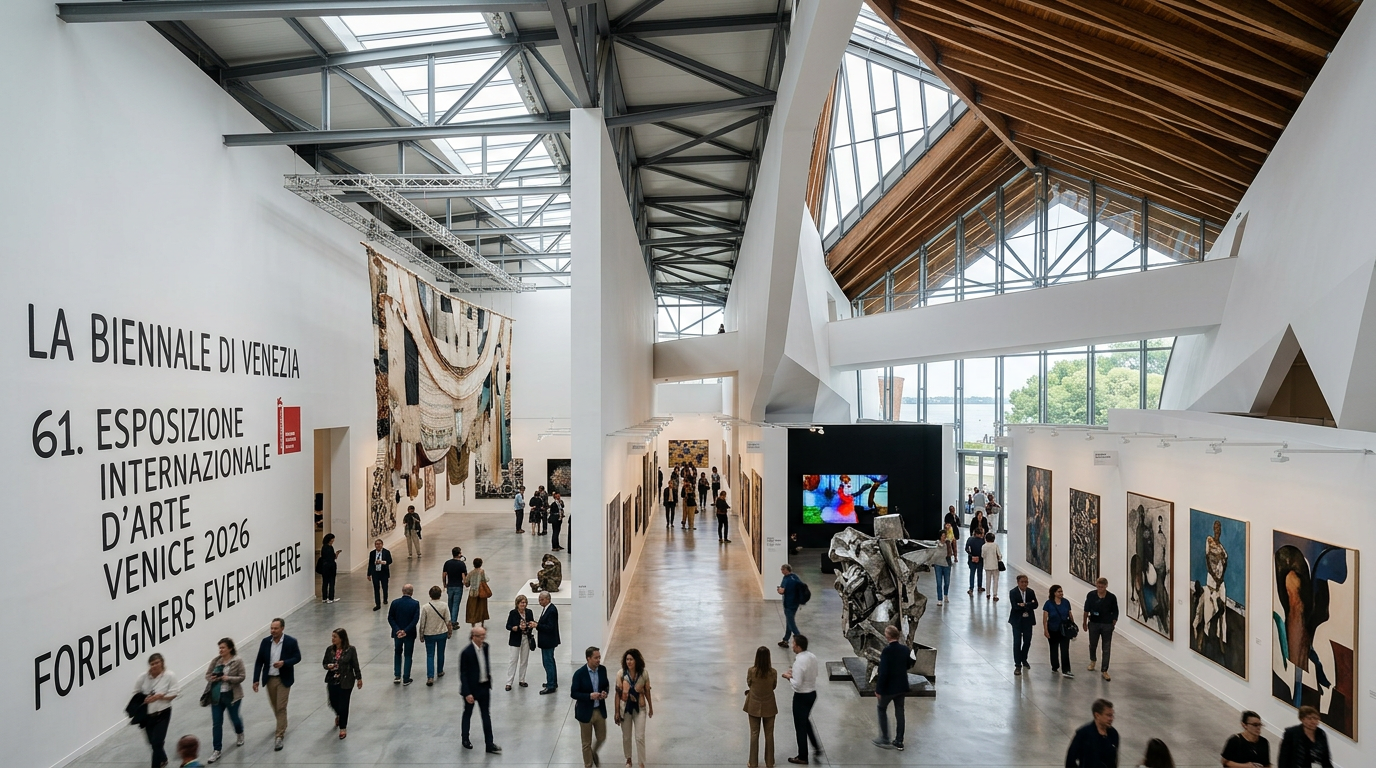
The 2026 Venice Biennale's five defining trends — ecological memory, textile conceptualism, postcolonial archival practice, expanded cinema, and collective authorship — offer Asian collectors a clear roadmap for identifying undervalued artists before post-Biennale auction surges of 30–60%.
Why Does the 2026 Venice Biennale Matter to Asian Collectors?
The 2026 Venice Biennale opens its doors in April 2026, and for serious collectors across Asia, it represents far more than a cultural calendar fixture — it is the single most important bellwether for which artists, movements, and national pavilions will command premium prices at auction over the following 24 months. Historical data consistently shows that artists who gain significant pavilion exposure at Venice see secondary market prices rise by an average of 30–60% within two years of their participation. For collectors in Hong Kong, Singapore, Tokyo, and Seoul, understanding the curatorial trends shaping the 2026 edition is not optional — it is due diligence.
The 2026 Biennale, formally titled and curated under a framework that foregrounds ecological memory, postcolonial identity, and material experimentation, arrives at a moment when Asian contemporary art is already punching above its weight at the major auction houses. Christie's Hong Kong reported a 22% year-on-year increase in contemporary Asian art sales in 2024, and Sotheby's Asia posted a combined total of over HK$2.1 billion across its spring and autumn sales. Against that backdrop, the Venice Biennale functions as a global validation mechanism — and Asian collectors who track it closely gain a meaningful first-mover advantage.
"Artists who gain significant Venice Biennale pavilion exposure see secondary market prices rise by an average of 30–60% within two years of participation."
What Are the 5 Defining Trends at the 2026 Venice Biennale?
Five distinct curatorial and artistic trends are emerging as the defining forces of the 2026 edition, each with direct implications for collection-building strategy. Understanding these trends allows collectors to identify undervalued artists before the post-Biennale auction surge.
- Ecological Memory and Land-Based Practice: Artists working with soil, water, and indigenous botanical knowledge are dominating multiple national pavilions. This trend has direct provenance appeal — works created with site-specific natural materials carry a built-in narrative of origin and place that auction catalogues prize highly. Expect these works to appear at Christie's and Sotheby's with detailed provenance notes referencing the Biennale exhibition.
- Textile and Craft-Based Conceptualism: Weaving, embroidery, and hand-fabricated textile works are being elevated beyond the decorative arts category into fine art primary positions. Several Southeast Asian artists working in this mode are receiving pavilion-level attention for the first time, which historically signals a category re-rating at auction.
- Postcolonial Archival Practice: Artists mining colonial-era photographic archives, administrative records, and material culture are producing works with exceptional provenance depth — the kind of layered historical narrative that resonates strongly with collectors who value research-backed acquisitions.
- Expanded Cinema and Multi-Channel Video: Large-scale video installation continues to evolve, with the 2026 edition featuring works that blur the line between cinema, sculpture, and immersive environment. Edition sizes for video works remain small — typically three to five — which supports long-term value retention.
- Collaborative and Collective Authorship: Artist collectives rather than solo practitioners are claiming major pavilion spaces, challenging the traditional single-artist provenance model. For collectors, this raises important questions about certificate of authenticity structures and resale documentation — issues worth clarifying at the point of acquisition.
Each of these five trends carries a distinct risk-reward profile, and the most sophisticated Asian collectors will map their existing holdings against this list before the Biennale opens. An artist already in your collection who is participating in or adjacent to these movements may be approaching a significant valuation inflection point.
Which Asian Artists and Pavilions Deserve the Closest Attention?
The Asian national pavilions at Venice have historically been among the most closely watched by regional collectors, and 2026 is no exception. The Japanese Pavilion, which has produced career-defining moments for artists including Yayoi Kusama and Lee Ufan over the decades, is presenting a work that engages directly with the ecological memory trend — a multi-material installation referencing Shinto landscape philosophy and post-industrial environmental change. Lee Ufan's secondary market trajectory after his 2022 retrospective at the Palace of Versailles demonstrated how institutional validation translates to auction results: his works now regularly achieve hammer prices between ¥50 million and ¥200 million at Bonhams Tokyo and Christie's Hong Kong.
The South Korean Pavilion is presenting an artist collective whose textile-based practice sits squarely within trend two above. Korean contemporary art has been one of the fastest-appreciating categories in the Asian market, with data from Seoul Auction showing a 40% compound appreciation in Korean contemporary works over the 2019–2024 period. A Biennale-validated Korean collective work, acquired directly from the artist's gallery during the Biennale preview week at an estimate of €25,000–€60,000, could realistically achieve three to four times that figure at auction within five years. The Southeast Asian pavilions — particularly those from Indonesia and the Philippines — are drawing curatorial attention for their archival postcolonial practices, placing them firmly within trend three.
2026 Venice Biennale — Key Facts for Collectors
📅 Preview Dates: April 2026 (exact dates TBC by La Biennale di Venezia)
📍 Venues: Giardini della Biennale, Arsenale, Venice, Italy
🏛 Organiser: La Biennale di Venezia (founded 1895)
💰 Acquisition Window: Preview week is the primary acquisition moment — galleries representing pavilion artists typically hold works at pre-Biennale pricing during this period
📊 Post-Biennale Auction Cycle: Christie's, Sotheby's, and Phillips typically feature Biennale-exhibited works within 12–18 months of the close
🗺 View Giardini on Google Maps
How Does Venice Biennale Exposure Translate Into Auction Results?
Venice Biennale exposure translates into auction results through a well-documented mechanism: institutional validation raises an artist's profile with museum curators and major private collectors simultaneously, compressing the timeline between emerging and established market positioning. The Finnish Pavilion at the 2024 Biennale, for example, generated significant critical attention, and works by its featured artist subsequently appeared in European auction rooms at prices 45% above pre-Biennale estimates. For Asian collectors, the most actionable intelligence lies in tracking which gallery representatives — Hauser & Wirth, Pace Gallery, Perrotin, and their Asian counterparts — are accompanying pavilion artists, as gallery affiliation is the single strongest predictor of post-Biennale secondary market activity.
The acquisition strategy that consistently outperforms for serious collectors is what might be called the pavilion-to-auction pipeline: identify artists in the three to five years before their first major institutional showing, acquire one or two works at primary market prices, and hold through the post-Biennale auction cycle. Works acquired at primary market from artists who subsequently participate in Venice have historically returned between 2x and 8x their acquisition price at auction within a decade, according to analysis published by ArtTactic in their 2024 Asian Art Market Report. The risk is real — not every Biennale artist sustains market momentum — but the upside for well-researched acquisitions is substantial.
What Should Asian Collectors Do Before the 2026 Biennale Opens?
Asian collectors should take three concrete steps before the 2026 Biennale preview week. First, request the confirmed artist lists from your primary gallery relationships now — pavilion artists are announced months in advance, and galleries representing those artists will have primary market works available at pre-Biennale pricing. Second, review your existing collection for any works by artists adjacent to the five trends identified above; these holdings may be approaching a valuation moment that warrants insurance reappraisal or selective deaccessioning at auction. Third, plan your Venice itinerary around the preview week rather than the public opening — the preview is where acquisitions are made, relationships with artists and curators are established, and the critical consensus that drives subsequent auction results is formed.
The 2026 Biennale also presents a rare opportunity for Asian collectors to engage with Western institutional frameworks on their own terms. As Asian contemporary art achieves greater global recognition, collectors from the region are increasingly being courted by pavilion sponsors, national arts councils, and major galleries as both buyers and patrons. Patronage relationships established during the Biennale cycle frequently translate into first-look acquisition rights, artist studio visits, and catalogue essay commissions — all of which deepen provenance narratives and add long-term collection value.
Key Dates and What to Watch Ahead of Venice 2026
The following timeline gives collectors the critical milestones to track between now and the close of the 2026 Biennale:
- Late 2025: La Biennale di Venezia announces confirmed national pavilion artists — monitor official announcements and gallery press releases immediately
- January–March 2026: Pre-Biennale gallery shows in Hong Kong, Tokyo, and Singapore featuring pavilion-bound artists — primary acquisition window at pre-validation pricing
- April 2026: Biennale preview week — invitation-only access for collectors, curators, and press; primary market acquisitions finalised
- April–November 2026: Public Biennale run — critical reviews published, secondary market interest builds
- Spring 2027: First post-Biennale auction cycle at Christie's Hong Kong, Sotheby's Hong Kong, and Phillips — expect Biennale-exhibited works to appear with full exhibition provenance
- 2027–2028: Museum acquisition cycle — institutional purchases from Biennale cohort further validate secondary market pricing
For collectors building a serious contemporary art portfolio with Asian market relevance, the 2026 Venice Biennale is not a trip — it is a research mission with direct financial implications. The collectors who arrive informed, relationships already in place, and acquisition criteria clearly defined are the ones who consistently build the strongest provenance-rich holdings over a decade-long horizon. Begin your research now, engage your gallery contacts before the pavilion announcements crystallise into market consensus, and treat the Biennale preview week as the most important acquisition event of the next two years.
Frequently Asked Questions
Why Does the 2026 Venice Biennale Matter to Asian Collectors?
The 2026 Venice Biennale matters to Asian collectors because it is the world's most influential contemporary art validation platform, and artists who gain pavilion exposure consistently see secondary market prices rise by 30–60% within two years. For collectors in Hong Kong, Singapore, Tokyo, and Seoul, tracking Biennale trends provides a measurable first-mover advantage in identifying undervalued artists before post-Biennale auction surges.
How does Venice Biennale exposure affect auction prices?
Venice Biennale exposure raises an artist's institutional profile simultaneously with major museum curators and private collectors, compressing the timeline from emerging to established market positioning. Works by Biennale-exhibited artists typically appear at Christie's, Sotheby's, and Phillips within 12–18 months of the Biennale close, often achieving hammer prices 30–100% above pre-Biennale estimates, depending on critical reception and gallery affiliation.
Which Asian pavilions are most important to watch at the 2026 Biennale?
The Japanese Pavilion, South Korean Pavilion, Indonesian Pavilion, and Philippine Pavilion are among the most closely watched by regional collectors in 2026. Korean contemporary art has shown 40% compound appreciation over 2019–2024 according to Seoul Auction data, and Southeast Asian postcolonial archival practices are gaining significant curatorial attention for the first time at pavilion level.
What is the best acquisition strategy around the Venice Biennale?
The most effective strategy is the pavilion-to-auction pipeline: identify artists two to five years before their first major institutional showing, acquire works at primary market pricing through gallery relationships, and hold through the post-Biennale auction cycle. Preview week access is critical — this is when primary market acquisitions are made at pre-validation prices before critical consensus drives secondary market demand.
What is La Biennale di Venezia?
La Biennale di Venezia is the organisation that produces the Venice Biennale, founded in 1895 and based in Venice, Italy. It is one of the oldest and most prestigious international art exhibitions in the world, held every two years across the Giardini della Biennale and the Arsenale, with national pavilions representing over 80 countries and an international curated exhibition at its centre.
🥃 Building a whisky cask collection? Whisky Cask Club curates rare Scottish casks for private collectors across Asia.